For school lessons
Atom builder
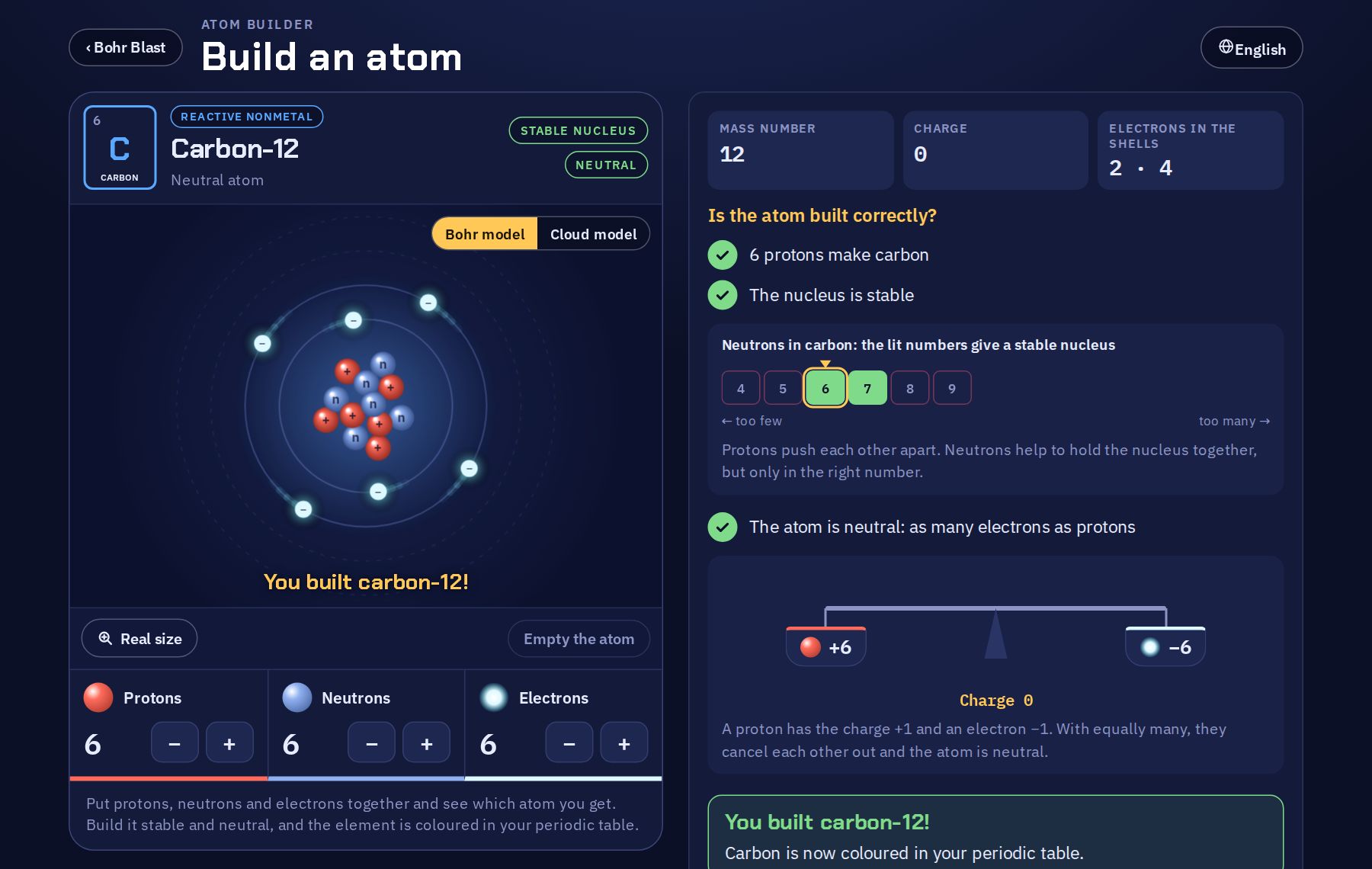
Put protons, neutrons and electrons together and see which atom you get. Build it stable and neutral, and the element is coloured in your own periodic table.
Three kinds of particles
The builder has a tray of protons, a tray of neutrons and a tray of electrons. Students add a particle with the plus button or drag it into the atom, and take it out again with the minus button.
The number of protons decides which element it is. The builder shows the name, the symbol, the mass number and the charge, and how the electrons are spread over the shells.
Is the nucleus stable?
Protons push each other apart. Neutrons help to hold the nucleus together, but only in the right number. A strip of numbers shows how many neutrons give a stable nucleus for the element being built, and whether the atom has too few or too many.
Carbon with 6 or 7 neutrons is stable. With 8 neutrons it is carbon-14, which is radioactive.
Atom or ion?
A proton has the charge +1 and an electron −1. A scale shows the two against each other. With equally many, the atom is neutral; otherwise it is a positive or a negative ion.
A periodic table of their own
Every element a student builds stable and neutral is coloured in their periodic table, from hydrogen to calcium: the first 20 elements. Clicking a built element brings it back.
The table is saved in the student's browser, not with us. A teacher can see on the student's screen how far they have got.
Two models of the atom
The Bohr model, with electrons in shells, makes the electrons easy to count. The cloud model is closer to reality: nobody can say where an electron is, only where it is likely to be found. In the cloud model students press Measure and see the electrons turn up in new places each time, until the dots form a cloud.
How big is an atom really?
In drawings the nucleus is far too big. In reality it is tens of thousands of times smaller than the whole atom. The Real size button shows the atom in its true proportions, and a slider zooms in until the nucleus can be seen.
Ideas for lessons
- Build the first ten elements in order and look at how the shells fill up.
- Build carbon-12, carbon-13 and carbon-14. What is the same, and what is different?
- Build a sodium atom and take one electron away. What is the charge now?
- Find every stable isotope of oxygen. How many are there?
Good to know
- The atom builder is on the website only, not in the app.
- It goes from hydrogen to calcium.
- It is free, in 18 languages, and needs no account.
- It works with touch, mouse and keyboard.