A learning game about the periodic table
Learn the periodic table by playing
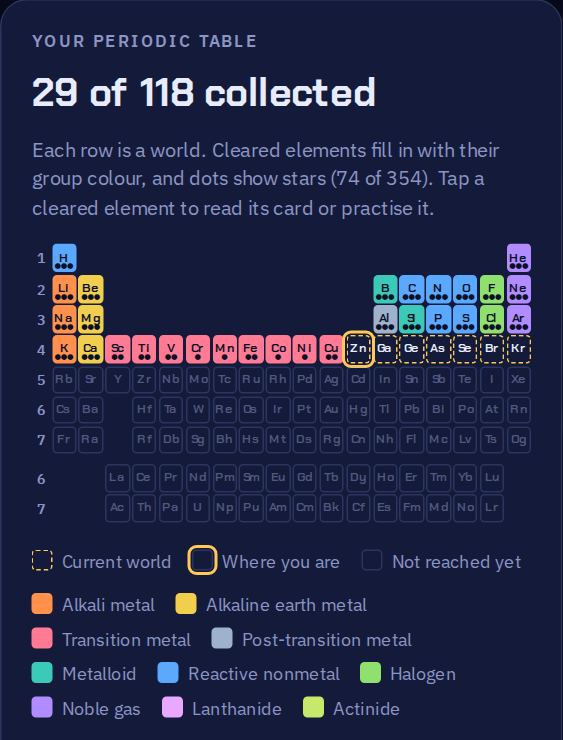
Bohr Blast is a game where you clear the nucleus of every atom in the periodic table, from hydrogen to oganesson. Every atom has its real number of protons, neutrons and electrons, so the pattern behind the table becomes visible while you play.
- 118
- elements
- 7
- worlds, one for each period
- 3
- difficulty levels
- Free
- for schools
How the game works
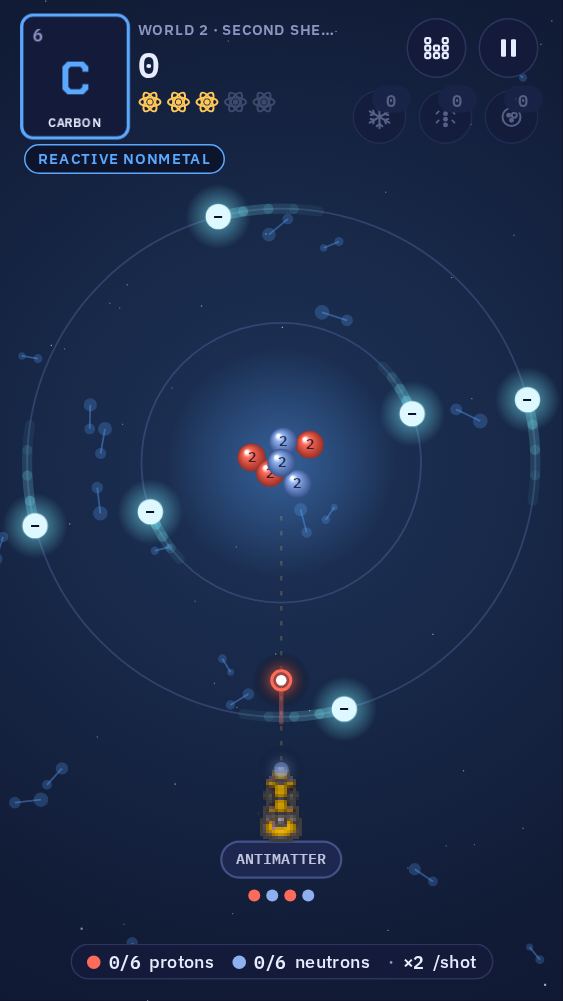
One element is one level. The atom is drawn as a Bohr model: a nucleus of protons and neutrons, with electrons circling in shells. You fire antimatter at the nucleus and have to time each shot so it passes through the gaps between the electrons.
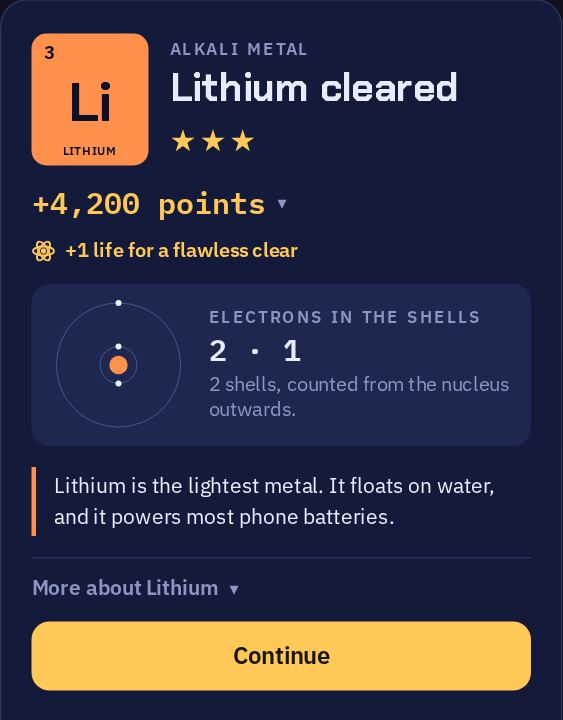
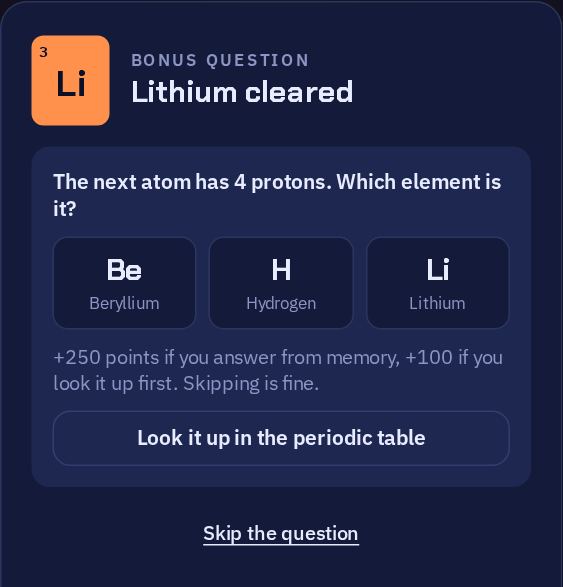
When the nucleus is empty, the element is cleared. You get a card with a fact about it, and then a quiz question about the next element.
What students learn
- The names, symbols and atomic numbers of all 118 elements.
- How an atom is built: protons and neutrons in the nucleus, electrons in shells.
- The real number of electrons in every shell, so it becomes clear why the periodic table looks the way it does.
- The groups of the table, such as noble gases, halogens and alkali metals.
- Isotopes, radioactivity and half-life in the later worlds.
Play with the whole class
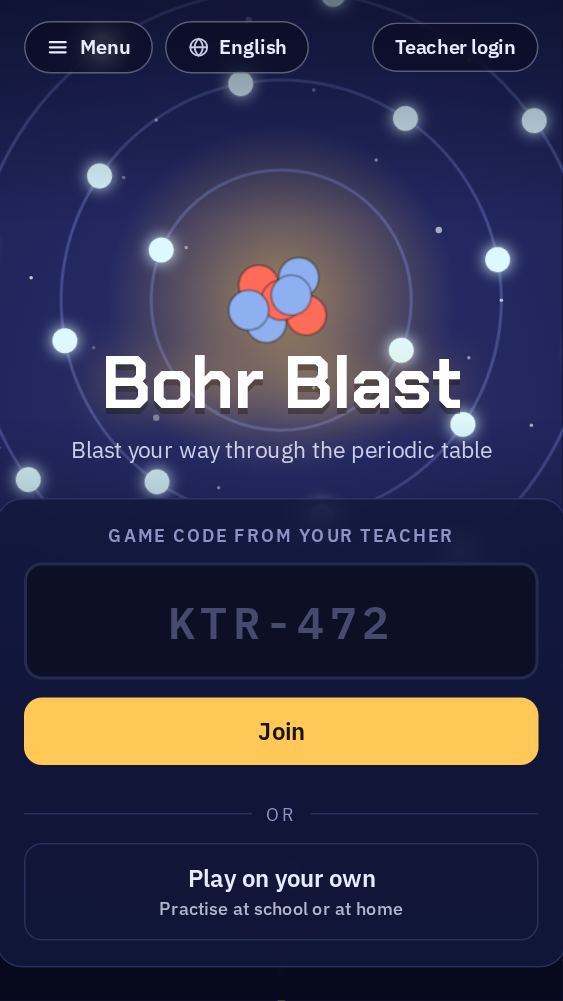
A teacher creates a class and gets a code. Students type the code on the front page and choose a name. They need no email and no account. The teacher starts a timed round, and the leaderboard is shown live on the big screen.
Playing with a class is free for schools, and it stays free.
Build atoms yourself
In the atom builder, students put protons, neutrons and electrons together and see which atom they get: which element it is, whether the nucleus is stable, and whether it is a neutral atom or an ion.
Runs in the browser
- On computers, tablets and phones, with nothing to install.
- In 18 languages. Questions can be read aloud.
- Three difficulty levels: Student, Researcher and Professor.
- No ads, no tracking and no third-party analytics.